Sunday, 21 October 2012

Total cost of ownership in Global sourcing

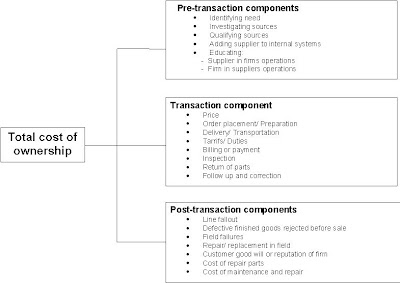
Total cost of ownership (TCO) is often underestimated or poorly analysed in global sourcing. Some reasons for this include lack of time, lack of a comprehensive framework, following strategic directive to global source,  lack of data for understanding the total cost. In this blog the focus is on the lack of a comprehensive overview for understanding the different cost elements involved in global sourcing. Adaptation of the famous and the much adapted total cost of ownership by Prof.Lisa Ellram is contextualized for global sourcing. Three broad elements of TCO has been (1) Pre transaction elements (2) Transaction elements (3) Post transaction elements. Pre transaction costs and post transaction costs are generally poorly considered. Most of the transaction costs are considered well in the TCO in actual practice. The below picture captures the TCO in global sourcing context.


Total cost of ownership in international purchasing
Total cost of Ownership in global sourcing
The detailed article could be downloaded from Here

Wednesday, 3 October 2012

Product characteristics influencing logistics of global sourcing

Global sourcing is an indispensable element in a globalising world. Product characteristics have a great influence on the ability to source globally. However a wholesome approach to understanding the product characteristics impact on global sourcing remains limited and is often neglected during product choice choice decisions for global sourcing. Based on the research work with engineering industries done by Linkoping University - Sweden, we have made an attempt to deduce the product characteristics influencing global sourcing. Underestimation of the characteristics reduces the cost saving potential in global sourcing. The picture below represents different product characteristics influencing logistics of global sourcing. Explanation of some product related factors follow. 


Value Density (Monetary value/Cubic feet) - The landed cost of the product can be higher by anywhere between 5% to 45% than the product purchase price at the low cost destination. Hence increasing the value density greatly reduced hidden and miscellaneous landed cost elements. For instance the value density of electronic goods per cubic feet is much more higher than value density of commodity cotton per cubic feet. 

Degree of standardisation to customer - Companies competing on customer responsiveness by increasing the customisation have to understand that global sourcing is a time consuming process. Hence it is wise to source produces with high responsiveness and quick delivery locally to ensure fast customisation and reduce lost opportunity cost. 

Standardisation of product/process - Increased standardisation enhances global supplier communication and also reduces impact of slow learning cost. For instance availability of clear and established technical drawings for engineering products increases the easiness of communication when compared to technical specifications under development. 

Demand stability - Stable and predictable demand is most preferred but unlikely to happen. Considering the longer pipeline inventories in global sourcing demand stability and understanding of demand pattern plays a crucial role in responsiveness and obsolete inventory. 

Each factors also have an interrelational influence. Decision making models like AHP serves as a suitable method for consensus decision making.   

The detailed article could be downloaded from Here

Tuesday, 21 June 2011

Logistics of LCC Sourcing

Increasing globalisation creates new possibilities for sourcing from low cost countries (LCC), but also comes with a range of logistics challenges and issues to be dealt with. The purpose of this paper is to investigate how logistics and its impacts are considered in LCC sourcing decisions. An exploratory multiple case study of industrial product companies engaged in distant LCC sourcing serves as an empirical base. Findings reveal that firms do not explicitly take logistics into account during LCC sourcing decisions. Even if logistics is considered, it is generally in a reactive way and takes a transactional cost focus. Instead, we propose a framework to proactively consider logistics factors in the early stages of LCC sourcing. This is done through identifying product and supplier related logistics factors and their impact on pre-transaction, transaction and post-transaction elements in the Total Cost of Ownership model.

The detailed article could be downloaded from Here

Monday, 6 September 2010

Moving out of Supply Chain after economic crisis

Purchasers and supply chain executives caution - during economy rebound

With the economic rebound expected to happen soon in the international market place, there are several aspects purchasing and supply chain executives need to take care of

Understand & ensure that the supplier is well informed – Recession has hit every on in the chain (Since its supply chains competing against each other and not companies). So it is important to ensure that the supplier is informed of the rebound and make a personal visit. This visit can ensure the availability of capacity, employee skills and a reaudit of the capability of the suppliers to bounce back. This is also a time for the OEM’s or supply chain captains to understand and listen to the problems of the suppliers. Its also worthy to ask how the supplier has survived the recession, to understand the resilience of the supplier.

Go till the tier 2 – Though most companies try to manage only the tier 1 companies, it is important to reuderstand the tier 2 companies of the supply chain. This ensures that the supplies are being streamlined and also that the tier 2 is able to ramp up production.

Check for new opportunities – Rebounce is a good time to check the existing structure of the supply chain. Check for new opportunities with existing suppliers and also check for new suppliers for old activities. New opportunities might open up because of technological changes, new cost reduction opportunities, change in supplier role and availability of new and better suppliers.

Monday, 28 December 2009

International purchasing and environmental sustainability - Can they co exist ?


After the Copenhagen climate change conference there has been an increasing interest in purchasing, logistics and supply chain professionals about how they can contribute towards making the world a better place. This is evident in the increase in the number of articles from supply chain magazines on environmental sustainability. Some people perceive international purchasing bestowed with poor environmental sustainability. However I choose to argue the opposite with the following reasons.


Multinationals have raised the need for addressing sustainability globally - With the increasing number of multinationals in developing countries, there is an increasing need to ensure that their suppliers are environmentally sustainable to be as suppliers to them. Hence multinationals have served as a major driver in creating awareness and systems for environmental sustainability. We know from the climate change that sustainability needs to be addressed as a global phenomenon and not as a local/regional phenomenon.


Intermodal transport is a great need - Russia has recently inaugurated a gas pipeline of more than 2250 km from Russia in to East Asia. This event will invoke discussion about the trans-siberian railway network which is supposed to connect China and Europe. With this network inline it would perhaps be less carbon intensive to transport goods from China in to Northern Europe when compared to truck transportation from southern Europe. Hence with such infrastructural and governmental level involvement it is possible to make international purchasing co exist.


Planning for sustainability - Products that are based on platform design, where there is a large amount of standardization and modularization involved could result in better predictability of demand, reduce variation, reduce obsolescence risk and also increase the scale of sourcing volumes. This could be coupled with postponement of manufacturing to nearby customer locations. Such logistics strategies increase environmental sustainability but still make it viable for international purchasing.


Cross functional integration - International supply locations act as good sources of sustainable designs and hence act as good reason to source from them. In order to adopt these good practices from international locations there is a need for good cross functional integration in the company. This aids better understanding of internal requirement and also external opportunities/ideas.


Tuesday, 22 December 2009

Supply chain quality - Going beyond functional silos

Large amount of energy and efforts have gone to develop frameworks for quality management in companies. TQM, TPM, ISO certification, Lean practices, six sigma quality are some exemplars of such frameworks focused on developing quality. However there are certain fundamental questions that are unanswered by these questions.

- When some companies are having more than 50% of their value addition from their supply base, is having these quality management focussed on internal company sufficient?

- At best what is visible when it comes to external supply quality management is objective performance monitoring - Can all quality parameters be objective in its nature and controlled by just measuring quality of supplies?

- Most of the internal quality management focusses on continuous improvement and companies have asked their suppliers for Kaizen, lean and other practices to harness the benefits of continuous improvement - But is continuous improvement preferred over rapid improvement considering rapid product changes, increasing need for radical innovation?

- Supply chain has focussed so much on the process way of managing things, How much is quality managed from a process perspective?

- Should quality be the issue of the quality department or be integral in the supply chain - if integral how do we implement and measure them?

- How should proactive thinking be integrated in the supply chain quality management?


Friday, 11 December 2009

Differentiating disturbances and disruptions in supply chain


When we talk about risk management in supply chains there are two typical parameters used in risk evaluation. They are severity of impact and the probability of occurrence (refer figure). This method of looking at risk has its roots in FMEA, where severity of the impact, frequency of occurrence and ability to detect are used as methods to assess risks.


It is interesting to differentiate between disturbances and disruptions. This helps to choose what type of strategies needs to be considered for different types of risks. Disturbances are high probability and low impact kind of events that needs to be constantly looked after. An example for this is the operational disturbances that companies need to handle constantly in supply chains. Disruptions are events that have low probability o occurrence but they have a high degree of impact in the supply chain. An example of this could be related to how the supply chains were affected during 9/11 attacks, Tsunami etc.., where these events do not occur on a daily basis, but when they occur there is a big impact on the supply chains.

Tuesday, 22 September 2009

Product characteristics affecting sustainablility

Much has been written and researched about the need for infusing sustainability in procurement , logistics and supply chain process. There is a common understanding and agreement about the increasing importance of sustainability for companies. However challenges like economic viability of being sustainable and availability of hands on tools for creating sustainability in organisational and functional processes remain.

This is an attempt to create tool for purchasing managers to identify sustainability based on the product characteristics. It includes characteristics like obsolocene risk and demand volatility which increases supply chain wastage, ease of disassembly/salvage, value density, packagability and product nature in terms of hazardous nature of product. The picture does not consider social and economic aspects of sustainability which needs to be infused in further development.

Wednesday, 12 August 2009

Sustainability & Innovations

When most of the developed countries are struggling for innovation

s to improve sustainability in operations, the developing countries - Fun pix


Calculate the carbon emission/person in this picture and compare it to the western world


Talking about reuse and Innovations for reuse


Value density of transportation


Environmentally friendly cars with zero emission


Monday, 10 August 2009

Environmental concerns in developing countries

The debates about how the developing economies of China and India are contributing to the increasing environmental concerns is never ending. However in this blog the intention is to put forward a few aspects in favor of the developing countries which I have seen as much more not evident.


@ the cost of economic development - India and China are possibly the two largest economies with a large capacity in recent times to purchase more automotive, expand their industries and "catch up" with missed boat of industrial revolution and economic development (Which the western economies have taken successfully taken - resulting in existing environmental concerns). Though the western world is fighting the issues of environmental sustainability, developing countries are fighting other priorities (Reducing hunger & poverty, wealth redistribution through employment creation). With increased pressure on just setting measures for developing countries to reduce environmental impacts western countries and international bodies should think about how to reduce environmental impacts without sacrificing economic growth. So the question for developing countries is not How to reduce environmental impact? but how to reduce environmental impact without sacrificing economic growth?


Screwed measures - One of the measure used on a global scale to measure environmental impact is the amount of carbon produced by each country. Even though China and USA comes at the top, there seems to be something fishy with the measure. Instead of the C02 emissions per country what would be an appropriate measure is the CO2 emissions per capita (meaning CO2 emitted per person in each country) in which developed countries would be having a higher environmental impact than developing countries.


Produced locally and consumed locally - In all the developed countries food comes from around the world for catering to the need for variety to customers. Its not uncommon to see in retail stores of Europe the Kiwi fruits from New Zealand, Meat from Australia, Grapes and other tropical from Peru/South America. The food miles travelled by these products are far higher than the food miles in developing countries. In developing countries food and grain are locally produced and consumed ( Thanks to the poor logistics infrastructure, lack of cold storage facilities and inability to industrialize food production), making them much more environmentally friendly.


Innovation is the key - concerns exists about waste water disposal, lack of clean water in the future, transportation infrastructure, product usage & disposal. When developing countries are in the process of improving or installing new infrastructure (transportation, building, waste disposal) developing countries have a better scope to be much more environmentally friendly than in developed countries (Given they understand and accept the importance of environmental friendliness).


It is everyones problem - Developing countries are increasingly made as the factories of the world. There will be little debate for the claim that "China is the factory of the world", "India as the IT hub of the world". While these global clusters are being formulated, developed countries naturally take the roles of supply chain orchestration, product & services development, technology development and customer satisfaction. Even though there are arguments that developing countries are substantially affecting environment, the impacts are global (like global warming). Hence the problem resolution has to be global rather than pushing the problem to specific developing countries/regions.


Saturday, 11 July 2009

LCC sourcing - tips & tricks

One of the typical problem in sourcing from LCC is that , purchasers believe that the pilot batch or the sample batch has no quality issues whereas most of the production batch has quality issues. Here is what a purchaser did in sourcing from China.............


A purchaser has to source 10000 nos/month components from a LCC supplier, however is aware that the sample batches are always better than the production batch. 


So he orders 10000 samples/ month  ;-)


The idea behind the story is to emphasize that local presence is necessary in sourcing from China or in LCC sourcing to enhance control. 


Source: Managing director - Enkey Engineering, India

Friday, 26 June 2009

The world is flattening


There seem to be two contradicting opinion/school of thought about globalisation. One if the famous argument put forward by Thomas L. Friedman that the world is flat and the other argument that the world is not flat. Instead of religiously following a specific thought school, in this blog I decide to take a factual approach to this commonly addressed debate.
Now for the school that advocates that the world is flat - this school cites the new mobility of workers happening globally, increased outsourcing, offshoring, increased information technology adoption, access to information for all people, disintegration of the value chain globally and performing the value addition where it could be done best ( global search for optimal competence) as attributes suggest that the world is flat.
The world is not flat - this can be argued by a series of questions - why are the differences between the rich and the poor still very high? Why are innovations mostly still taking place in the silicon valley? Why are cities like Frankfurt, Hong kong, New York and London still in the height of activity than others? Why is agriculture still not globalised and integrated across economies?. Disparities between economies in terms of population, innovation, electricity, etc point to the direction that the world is not flat in fact it is argued as being spiky.

The truth lies somewhere in between - simply termed as the world is in the process of getting flattened at a faster pace than ever before, however we have still not reached there (The world being flat) and we will never reach there also.

Wednesday, 1 April 2009

Indian business network

Rajeev (father): "I want you to marry a girl of my choice."
Son: "I will choose my own bride!!!"
Rajeev: "But the girl is Bill Gates's daughter.."
Son: "Well, in that case... ok"
Next Rajeev approaches Bill Gates.

Rajeev: "I have a husband for your daughter...."
Bill Gates: "But my daughter is too young to marry!!!!!"
Rajeev: "But this young man is a vice-president of the World Bank."
Bill Gates: "Ah, in that case... ok"
Finally Rajeev goes to see the president of the World Bank.

Rajeev: "I have a young man to be recommended as a vice-president."
President: "But I already have more vice- presidents than I need!"
Rajeev: "But this young man is Bill Gates's son-in-law."
President: "Ah, in that case... ok"

Source: E mail forwards

Tuesday, 3 February 2009

Six step International Purchasing Office (IPO) set up procedure


There has been a sharp increase in the number of International Purchasing Office in recent times. What remains unfolded is the process of IPO setup and operation. Based on the research so far and the discussions with industry experts – I have charted a few steps that successful companies have done in regard to the IPO setup. 

(1)   Identify the opportunities of the Indian supply market

What remains a mystery is a documented approach towards understanding the supply market for foreign companies. Most multinationals stereotype India as an exotic country of snake charmers and national highways with elephants rides. IPO’s typically need to create knowledge about the nature of the Indian supply market and its potentials. 

(2)   Identify and select suppliers to partner with 

International sourcing involves long term association with suppliers to partner with. This is the case to build a sustainable supply platform from India hence the choice of the supplier and long term sustainability is important. 

(3)   Identify the internal and external coordination processes necessary

Successful IPO operations need good adaptation and integration of both external and internal coordination processes. Internal coordination includes coordination within the same function, across different functions and business units. External coordination includes coordination with suppliers and other service providers.

(4)   Hire, train and retain talent at IPO 

Given the challenges of IPO it is important to hire the right talent of people. Even more important is to train and retain the talent for IPO. Purchasing in IPO is much more of a balance between strategic skills and operational capability.

(5)   Set internal and external performance measures 

IPO’s in particular are service centres for global operations of Multi national companies, IPO’s are savings generators rather than revenue generators. It is important and critical to set the performance measures for IPO based on internal and external issues

(6)   Develop, monitor and sustain supply base 

Rather than selecting suppliers, supplier development is more essential for companies. This helps to sustain the savings from supply base. Monitoring the supply base and also constant feedback to suppliers will help improve the supply base. 
Friday, 2 January 2009

Risk Assessment – Should the trigger be time period driven or event driven?

Most companies believe that their supply chain is constantly at risk and new risks are added in the course of evaluation. A McKinsey report (2006) also claims that though supply chain managers are aware of the impact of these risks, they are seldom prepared to handle them. It becomes necessary to assess the risks in supply chain – then it typically leads to two questions (1) How often should risks be assessed and (2) When should the risks be assessed?

Most companies have a risk assessment system in place and perform them on a quarterly or half yearly basis. Some companies perform risk assessment based on occurrence of certain events in supply chains. The best method is however a combination of both. The below are certain events which should trigger risk assessment in the supply chain

  • Addition of a new supplier, customer, resource or product in the supply chain
  • Major change in the companies supply chain strategy, big projects
  • Due to changes or increasing uncertainty in the business environment (Competitors move, Geo political issues)
  • At the juncture of major decision making like outsourcing, Make or buy etc..,

Monday, 3 November 2008

Managing logistics in global sourcing


Increasing global sourcing increases the lead-time and also inventory in the supply chain. Companies generally face challenges of obsolescence and difficulty to manage supply chain volatility. Hence there is tremendous pressure on logistics issues in global supply chain activities.

Logistics is more than a Total cost approach
Companies consider logistics more from a cost perspective companies seldom take a more serious approach or perspective towards logistics. Companies involved in global sourcing perform calculation of increased inventory cost and other logistics cost.

Inventory positioning for strategic advantage
Inventory plays a critical role in the supply chain. Most companies take inventory as a burden, however inventory can also be positioned for strategic advantage in global sourcing. Global sourcing typically goes for 20-40% cost savings and inventory cost increase is generally about 10-15%.For instance inventory increase should be used with other logistics strategy like coordinating with TPL for fast response, rationalisation of logistics facilities for strategic advantage etc...,

Rethink logistics coordination
There is a desperate need to change logistics coordination to take full advantage of global sourcing. Consider Walmart which is a pioneer in global sourcing, they have mastered strategies like cross docking as a means to reduce inventory in the supply chain and at the same time capitalise on global sourcing.

Wednesday, 22 October 2008

Global sourcing – Generating sustainable value


Global sourcing is predominantly done for cost reduction reasons. However we all are aware that cost is rising in countries like China, India and other low cost countries. So purchasers are constantly faced with sustaining the cost advantage of 20-40% from sourcing from these countries. Here are a few methods with which cost savings can be sustained.

Constantly iterate product portfolio
Most global sourcing activities start with simple labor intensive products to test the suppliers technical and logistics capability. However sourcing is not limited to these products. As and when the purchasers understand the capability of the suppliers they begin to constantly try sourcing different products. So there is a constant need to reiterate the products that are sourced.

Increase the value generated from Supply network
Though component sourcing is very common in these countries, companies are moving towards module and system level sourcing. i.e. increasing the value generated from the supply network. For instance an aluminium casting manufacturer once a component supplier, now is getting involved in product development activities and designing the aluminium systems hence increasing the value generated. Generally the supplier needs some efforts from the buyers in terms of technology transfer, product development cost sharing etc.., to make these things happen.

Develop supply base to enable market access
Rather than selecting the supplier developing the supplier seems to work in the long run. Some companies are smart enough to develop the sourcing base for specific product lines that will be sold in these countries in the near future. In a way they develop a sourcing base not only for their global operations but also so set up supply base for potential market entry.

Global SCM Innovate – Integrate – Rationalise
Constant innovation from the supply network and efforts to integrate the benefits of the supply network in to the global supply chain renders good results. But certainly a saturation point arises with constant innovation and integration and that when there is a need for rationalisation and rethinking of supply chain. With this approach and looking at global sourcing as an opportunity beyond sourcing helps to sustain the value generated.

Tuesday, 21 October 2008

Visualising Friedman’s Flat world


Friedman’s book “The world is flat” has created a huge impact in understanding the flat world. He argues that the invention of the Netscape browser, Windows operating system and the workflow software as the fundamental areas that created the movement of work in the flat world.
Other phenomenon like offshoring, Outsourcing, Insourcing, informing, open sourcing, Supply Chaining are more of steriods in creating the flatworld. Here is a pictorical representation of Firedman’s idea of the flatworld.

Hindering Global Sourcing


Global sourcing is an area that has been on the agenda for may companies since the WTO treaty of 2000 and the integration of countries like China and India in to the global trade. However services seems to have take a higher impact on global sourcing than manufacturing given the potential for global sourcing activities in manufactured products. There are several factors that hinder global sourcing here are a few internal and external factors.

Internal Resistance

Most of the companies are facing an internal resistance to move from a supplier near shore to a supplier offshore. This is even more difficult for supply networks where relationship is a necessary pre requisite. Cultural differences, difficulty of coordination and communication, poor change management to accept new suppliers, very low affinity to take risks and organisational inability to unlearn & relearn creates internal resistances in global sourcing.

Process stabilisation

Companies pick the potential products and fish for suppliers to deliver their products and the expectations are an immediate 30% reduction in price. But in LCC like China and India there is generally a high learning cost and establishment time. So to reach a stabilised process of global sourcing takes time to reach which is generally under estimated. Apart from this companies also have to understand that costs are rising in countries like China and India, so to secure the saving potential global sourcing process should constantly work with new product portfolio’s of sourcing.

Fluctuations in Currency and Commodity

There are large fluctuations in the commodity market of prices of metals and other raw materials. This fluctuation is also clubbed with the fluctuations in the currency market which creates price volatality and uncertainity in global sourcing deals. Smart hedging is required to accommodate these fluctuations in the supply chain.

Getting Sourcing Logistics right

With increasing fuel prices and challenges faced by the transportation industry logistics cost are increasing and changing the scope of global sourcing activities. Most companies feel that the landing cost at site is different than the cost of sourcing it in the LCC. So companies clearly have to work with Transportation companies and also with TPL guys to evaluate the costing on a landed cost basis. Apart from the cost coordinating with the TPL or logisitcs companies to get the sourcing also increases the delivery reliability.

Monday, 15 September 2008

Tier 2 supply network in India – A grey area

Supply chains across the world face common challenges of supplier rationalisation, increased outsourcing, product development and value generation from the supply network. The scenario is the same for companies in India. As far as the Indian Supply network is concerned the tier 1 suppliers are truly world class like the TVS group, Bharat forge etc.., However there seems to be substantial challenges with the tier 2 supply network.

With the growth pressure increasing for companies in the tier 1 level, there is also a pressure to increase the average scale of the tier 2 suppliers. Traditionally the subsidies and labor union laws have not increased the average scale of business operations. Government has encouraged only small scale operations and have made the supplier network structurally weak of the supplier capability of tier 2 network. But there has never been a higher need than today to increase the scale of the companies and also to increase the value generated from the tier 2 network.